

AESTURA
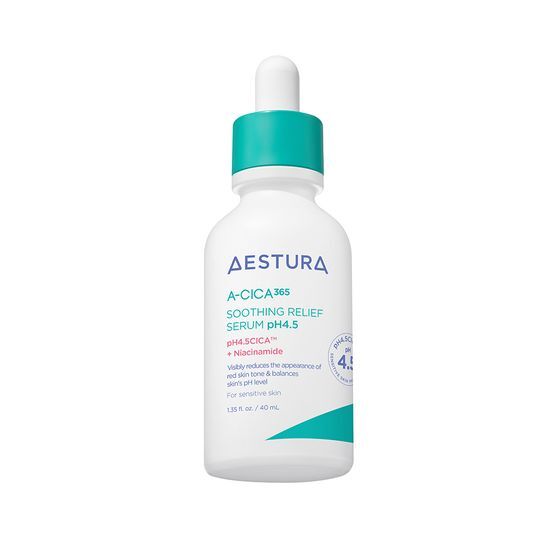
AESTURA A-CICA 365 Soothing Relief Serum pH4.5 40ml
pH 4.5, printed on the box.
Thirty-two ingredients, four of them centella actives — and a number the brand was willing to commit to.
Thin, quick, no film.

What this serum does
A 40 ml serum held at a mildly acidic pH, carrying four isolated centella actives with Niacinamide, Gluconolactone and 3-O-Ethyl Ascorbic Acid, formulated for skin that reddens easily.
Why a number on the label is worth something
Healthy skin sits somewhere around pH 4.5 to 5.5. Products that push it higher take longer to settle, and reactive skin notices. Stating the figure on the packaging is a commitment most brands avoid, and here it is backed by Gluconolactone, Sodium Gluconate and Tromethamine — the buffering system that holds it there.
Key ingredients
Ingredient · What it is, and what it is used for
- Madecassoside
- Triterpene glycoside from Centella asiatica. Used to calm irritation.
- Asiaticoside
- The best studied of the centella triterpenes. Used to calm the look of redness.
- Madecassic Acid
- One of the isolated triterpenes from centella. Naming it means the active is measured in, not just carried along in a whole-plant extract.
- Asiatic Acid
- Another isolated centella triterpene. Used to calm the look of redness.
- Niacinamide
- Vitamin B3. Studied for evening out the look of tone, for the look of pores, and for breakout-prone skin — which is why it turns up in so much of this catalogue.
- Gluconolactone
- Polyhydroxy acid. Ties up trace metals so the formula keeps; pulls water into the surface and holds it there.
- 3-O-Ethyl Ascorbic Acid
- Stable vitamin C derivative. Slows oxidation, in the formula and on skin.
- Zinc PCA
- Zinc salt of pyrrolidone carboxylic acid.
- Squalane
- Saturated hydrocarbon, hydrogenated squalene. A material skin already contains, so it reads as its own; used to soften by filling the gaps between surface cells.
- Cholesterol
- Sterol. One of the three lipid classes skin's outer layer is built from — ceramides and fatty acids are the other two, and they work as a set rather than alone.
- Sodium Hyaluronate
- Sodium salt of hyaluronic acid. A material skin already contains, so it reads as its own; used to pull in water and hold it.
- Betaine
- Amino acid derivative from sugar beet. Used to pull in water and hold it.
How the formula works together
Three groups. The centella quartet works on the look of redness. Niacinamide, 3-O-Ethyl Ascorbic Acid and Zinc PCA work on the look of tone and sebum. Squalane and Cholesterol give the surface material back.
Gluconolactone sits in an interesting position — high on the list, above the actives. At that placement it is functioning as much as a humectant and buffering agent as an exfoliant, which is consistent with a serum built for skin that cannot take a stronger acid.
Thirty-two ingredients, no fragrance and no essential oil.
Who it is for
Labelled for sensitive, redness-prone skin, with a redness sensitivity test completed.
How to use it
- After toner, apply a few drops over the whole face.
- Press a little more onto the areas that flush first.
- Use morning and night; follow with a moisturiser.
Details
- Size
- 40 ml
- pH
- 4.5, as stated by the brand
- Made in
- Korea
- Ingredients
- 32, published in full below
Full ingredient list
Water, Glycerin, Butylene Glycol, Dipropylene Glycol, Betaine, Niacinamide, Gluconolactone, 1,2-Hexanediol, Diethoxyethyl Succinate, Tromethamine, Sucrose Stearate, Squalane, Hydrogenated Lecithin, Polyglyceryl-10 Stearate, Polyglyceryl-10 Laurate, Carbomer, Caprylyl Methicone, Polyacrylate Crosspolymer-6, Ethylhexylglycerin, Cholesterol, Xanthan Gum, Asiaticoside, Madecassic Acid, Asiatic Acid, Sodium Hyaluronate, Cellulose Gum, 3-O-Ethyl Ascorbic Acid, Zinc PCA, Sodium Gluconate, Glyceryl Caprylate, Madecassoside, Sodium Trimetaphosphate
In label order, unedited.
Ships from Korea.


