

AESTURA
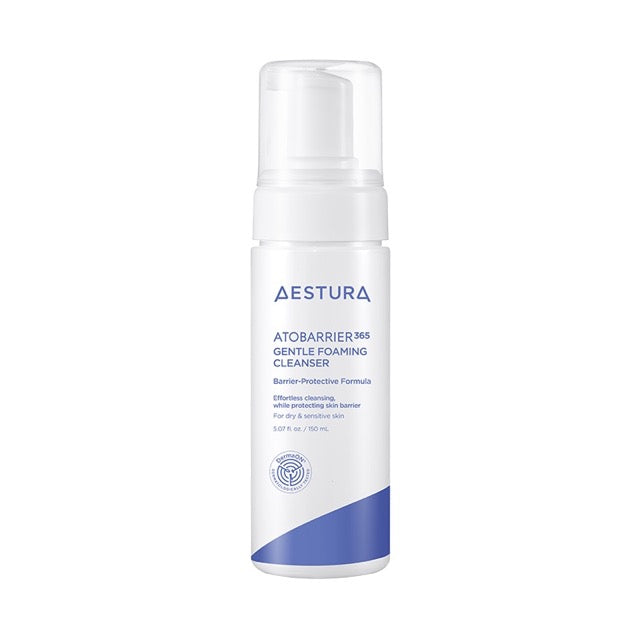
AESTURA Atobarrier 365 Gentle Foaming Cleanser 150ml
The wash that leaves your barrier where it found it.
Squalane and barrier lipids in a rinse-off product, which almost nothing manages.
Low foam, no tight feeling after.

What this cleanser does
A 150 ml low-pH foaming cleanser carrying the three lipid classes found in the outer layer of skin — a ceramide analogue, cholesterol and a sphingoid base — alongside Squalane, formulated to clean without stripping and to leave skin soft rather than tight.
Barrier lipids in a rinse-off product
Most cleansers are surfactant and thickener. This list carries Hydroxypropyl Bispalmitamide MEA and Hydroxypropyl Bislauramide MEA — ceramide analogues — with Cholesterol and Phytosphingosine beside them. Those three classes are what the skin barrier is built from, which is an unusual thing to spend on in a product designed to be rinsed away.
Key ingredients
Ingredient · What it is, and what it is used for
- Hydroxypropyl Bispalmitamide MEA
- Ceramide analogue (pseudoceramide).
- Hydroxypropyl Bislauramide MEA
- Ceramide analogue (pseudoceramide).
- Cholesterol
- Sterol. One of the three lipid classes skin's outer layer is built from — ceramides and fatty acids are the other two, and they work as a set rather than alone.
- Phytosphingosine
- Sphingoid base. The backbone that ceramides are built on, and it occurs in your own lipid layer.
- Squalane
- Saturated hydrocarbon, hydrogenated squalene. A material skin already contains, so it reads as its own; used to soften by filling the gaps between surface cells.
- Glycerol
- Polyol. A material skin already contains, so it reads as its own; used to pull in water and hold it.
- Allantoin
- Heterocyclic diureide. Used to calm irritation.
- Mannitol
- Sugar alcohol. Pulls water into the surface and holds it there.
- C12-20 Alkyl Glucoside
- Sugar-derived non-ionic surfactant. Keeps oil and water from separating; does the cleansing.
- Arachidyl Glucoside
- Sugar-derived non-ionic surfactant. Keeps oil and water from separating; does the cleansing.
- Behenyl Alcohol
- C22 fatty alcohol. Stops the mix separating over time; sets how thick it is.
- Caesalpinia Sappan Stem Powder
- Powder from Caesalpinia sappan stem.
How the formula works together
The cleansing is done by glucoside surfactants — sugar-derived, non-ionic — rather than by soap. That choice sets the pH low and keeps the finish from squeaking. Around them sit the barrier lipids and Squalane, which is the part that matters after the water has gone.
A stripped barrier is why skin can feel tight at the basin and greasy an hour later. Putting the lipid classes back into a rinse-off step is a way of making the wash cost less than it usually does.
Who it is for
Labelled for dry, sensitive and barrier-compromised skin. Positioned as a morning wash, or as the second step after an oil cleanser.
How to use it
- Work a small amount into a lather with water.
- Massage over damp skin, avoiding the eye area.
- Rinse thoroughly with lukewarm water.
Details
- Size
- 150 ml
- Made in
- Korea
- Skin type
- Dry, sensitive, barrier-compromised
- Ingredients
- 39, published in full below
Full ingredient list
Aqua, Glycerol, Butylene Glycol, Butylene glycol dicaprylate/dicaprate, Pentaerythrityl tetraisostearate, Squalane, Cyclopentasiloxane, Cetearyl octanoate, Behenyl Alcohol, C14-22 alcohols, Stearic Acid, Hydroxypropyl Bispalmitamide MEA, Mannitol, Cyclohexasiloxane, Hydroxypropyl Bislauramide MEA, Arachidyl alcohol, Cholesterol, Polyacrylate-13, Allantoin, Carnauba Wax, C12-20 Alkyl Glucoside, Arachidyl Glucoside, Dimethiconol, Polyisobutene, Phytosphingosine, Glyceryl caprylate, Carbomer, Tromethamine, Acrylates/ammonium methacrylate copolymer, Ethylhexylglycerin, Silica, Polysorbate 20, Sorbitan isostearate, Glucose, Icosanoic acid, Hexadecanoic acid, Caesalpinia Sappan Stem Powder, Oleic Acid, Tocopherol
In label order, unedited.
Ships from Korea.


