

COSRX
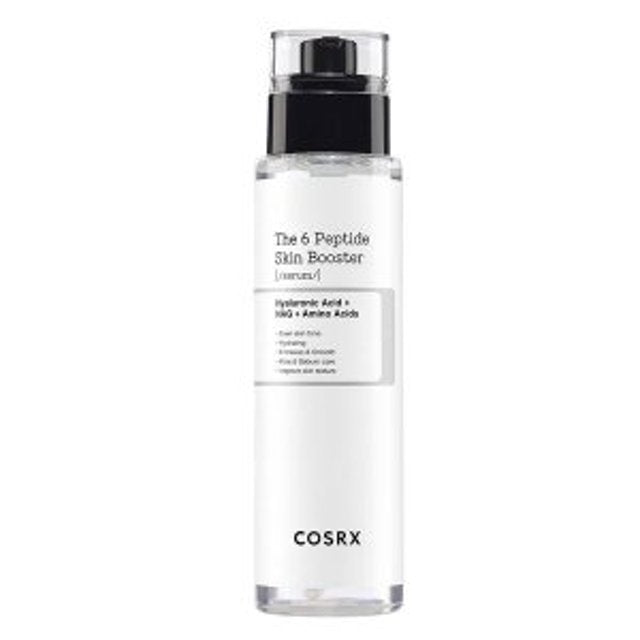
COSRX The 6 Peptide Skin Booster Serum 150ml
Six peptides, and the name is literally true.
We counted: positions 21, 22, 24, 34, 37 and 40 of forty-four.
Watery, and 150 ml goes a long way.

What this serum does
A 150 ml first-step booster serum carrying six named peptides, Niacinamide at position six, and a full reconstruction of skin's own natural moisturising factor.
The six, and why they are six different ideas
A product can put six peptides on a label by listing six near-identical materials. This one does not — each of these comes from a different line of research.
Acetyl Hexapeptide-8 (21) is the most widely used cosmetic peptide there is, studied for expression lines. Copper Tripeptide-1 (22) is a copper-bound tripeptide, one of the oldest and most researched peptides in skincare. sh-Polypeptide-121 (24) carries the "sh-" prefix, which means a human protein made by bioengineering rather than chemical synthesis — a different class of material entirely.
Dipeptide Diaminobutyroyl Benzylamide Diacetate (34) was modelled on a component of temple viper venom, which is where its reputation comes from. Oligopeptide-68 (37) is used in tone-focused formulas. Palmitoyl Tripeptide-8 (40) has a fatty acid tail attached so it can cross a lipid layer, and is used where a formula is aimed at reactive skin.
Six peptides, six mechanisms. That is a formulator building a stack rather than padding a claim.
The other half: NMF, rebuilt
Positions 19 to 38 hide something most people scroll past: Sodium PCA, Sodium Lactate, PCA, then Serine, Alanine, Glycine, Glutamic Acid, Lysine HCl, Threonine, Arginine and Proline.
That is natural moisturising factor — the water-binding mixture inside skin's own surface cells, which is roughly half free amino acids with PCA and lactate making up most of the remainder. Serine, glycine and alanine are the most abundant in real NMF, and they are placed highest here.
COSRX uses this same block in its Skin Barrier Moisturizing Cream. It is the quiet good idea in both products, and neither one advertises it.
Key ingredients
Ingredient · What it is, and what it is used for
- Acetyl Hexapeptide-8
- Synthetic hexapeptide, the one sold as argireline. Studied for the look of expression lines.
- Copper Tripeptide-1
- Copper-bound tripeptide, GHK-Cu. Studied for the look of firmness.
- sh-Polypeptide-121
- Bioengineered human polypeptide — grown rather than synthesised. Leaves a light film on the surface.
- Dipeptide Diaminobutyroyl Benzylamide Diacetate
- Synthetic dipeptide, modelled on a component of temple viper venom.
- Oligopeptide-68
- Synthetic oligopeptide.
- Palmitoyl Tripeptide-8
- Tripeptide with a palmitic acid tail attached so it can cross a lipid layer.
- Niacinamide
- Vitamin B3. Studied for evening out the look of tone, for the look of pores, and for breakout-prone skin — which is why it turns up in so much of this catalogue.
- Polyquaternium-51
- Phosphorylcholine polymer, built to resemble the outer surface of a cell membrane. Uncommon and costly.
- Sodium PCA
- Salt of pyrrolidone carboxylic acid. One of the two largest non-amino-acid fractions of skin's own NMF.
- Serine
- Amino acid. The single most abundant amino acid in human natural moisturising factor.
- Acetyl Glucosamine
- Acetylated amino sugar. Often paired with niacinamide on tone.
- Adenosine
- Purine nucleoside. One of the few ingredients Korea approves a wrinkle-care claim for.
How the formula works together
The first six entries are water, three glycols and niacinamide. Then the structure: Ammonium Acryloyldimethyltaurate/VP Copolymer, Polyacrylate Crosspolymer-6 and Xanthan Gum, which give a watery serum enough body to sit on the face while you press it in.
Polyquaternium-51 at thirteen is worth pausing on. It is a polymer designed to mimic the phosphorylcholine surface of a cell membrane, so it holds water the way a membrane does rather than the way a sugar does. It is expensive and rarely used, and it is here at a position that suggests a real amount.
There is almost no oil — Glycine Soja (Soybean) Oil and Hydrogenated Lecithin near the end, present to carry the tocopherol and the fat-tailed peptide, not to moisturise. That is why this absorbs to nothing and why it works as a first layer under everything else.
Forty-four ingredients, no fragrance and no essential oil on the list.
Who it is for
Labelled for all skin types, as the first step after cleansing. At 150 ml it is priced and sized to be used generously — which is the correct way to use a booster. No acids, no retinoid, no fragrance, so it layers under anything.
How to use it
- After cleansing, use it as the first skincare step.
- Spread over the whole face while skin is still damp.
- Apply two or three layers if you want more — it is built for that.
- Follow with your serum or ampoule, then moisturiser.
Details
- Size
- 150 ml
- Made in
- Korea
- Peptides
- 6, at positions 21, 22, 24, 34, 37 and 40
- Also contains
- 8 free amino acids, PCA, Sodium PCA and Sodium Lactate
- Ingredients
- 44, published in full below
Full ingredient list
Water, Dipropylene Glycol, Glycerin, Pentylene Glycol, 1,2-Hexanediol, Niacinamide, Ammonium Acryloyldimethyltaurate/VP Copolymer, Polyacrylate Crosspolymer-6, Butylene Glycol, Xanthan Gum, Ethylhexylglycerin, Adenosine, Polyquaternium-51, Disodium EDTA, Citric Acid, Caprylyl Glycol, Betaine, t-Butyl Alcohol, Sodium PCA, Sodium Lactate, Acetyl Hexapeptide-8, Copper Tripeptide-1, PCA, sh-Polypeptide-121, Serine, Alanine, Allantoin, Sodium Hyaluronate, Acetyl Glucosamine, Glycine, Glutamic Acid, Lysine HCl, Threonine, Dipeptide Diaminobutyroyl Benzylamide Diacetate, Arginine, Tocopherol, Oligopeptide-68, Proline, Dextran, Palmitoyl Tripeptide-8, Glycine Soja (Soybean) Oil, Hydrogenated Lecithin, Potassium Sorbate, Sodium Oleate
In label order, unedited.
Ships from Korea.


