

MEDIHEAL
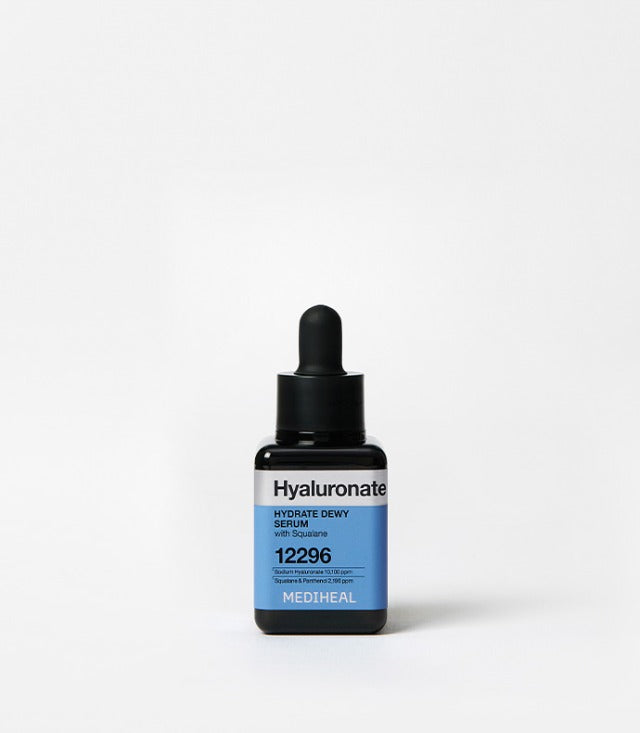
MEDIHEAL Hyaluronate Hydrate Dewy Serum 40ml
Ten hyaluronates, each one measured on the label.
Nine of the ten are declared in parts per billion — MEDIHEAL printed the numbers themselves.
Dewy, and it layers thin.

What this serum does
A 40 ml serum carrying Sodium Hyaluronate at a declared 1.01%, with Niacinamide at position five, Ceramide NP, Squalane and Adenosine. Nine further hyaluronates are present in traces.
The numbers, converted
This label declares a concentration for every hyaluronate. Here is what those figures mean.
Ingredient · Declared · As a percentage
- Sodium Hyaluronate
- 10,100.01 ppm
- 1.01%
- Dimethylsilanol Hyaluronate
- 15 ppb
- 0.0000015%
- Hydrolyzed Hyaluronic Acid
- 15 ppb
- 0.0000015%
- Hydrolyzed Sodium Hyaluronate
- Hyaluronate cut small enough to sink past the very top layer rather than sitting on it.
- 0.0000015%
- Hyaluronic Acid
- 10 ppb
- 0.000001%
- Potassium Hyaluronate
- 10 ppb
- 0.000001%
- Hydroxypropyltrimonium Hyaluronate
- Hyaluronate given a positive charge so it sticks to skin instead of rinsing away.
- 0.0000008%
- Sodium Hyaluronate Crosspolymer
- Cross-linked hyaluronate. The cross-linking stops it washing away as fast as the plain form, so it keeps working on the surface for longer.
- 0.0000008%
- Sodium Hyaluronate Dimethylsilanol
- 5 ppb
- 0.0000005%
- Sodium Acetylated Hyaluronate
- Acetylated hyaluronate. Modified to be less water-loving than the plain form, so it clings to the surface instead of rinsing straight off.
- 0.0000004%
Parts per million and parts per billion differ by a factor of a thousand. The nine trace hyaluronates come to 90 ppb combined — in a 40 ml bottle, roughly four micrograms of material in total. They exist so the box can say ten types. They are not doing anything.
But the tenth one is the real thing
Here is the part that makes this a good serum anyway.
Sodium Hyaluronate at 10,100 ppm is 1.01%, and that is a high dose. Most hyaluronic acid serums use somewhere between 0.1% and 0.5%; above about 1% a formula starts to feel tacky and gets difficult to work with. This one is at the top of the usable range, and the brand told you so in a unit almost nobody converts.
So: ignore the "ten types" entirely and judge this as a 1% hyaluronic acid serum with niacinamide. On that basis it is well dosed and honestly labelled — the information was all there, just buried.
What is around it
Niacinamide at five, above every texture ingredient. Squalane (18) and Ceramide NP (19) supply a small amount of lipid, which matters — hyaluronic acid holds water but cannot stop it leaving, and a pure humectant serum on dry skin can end up feeling worse than nothing.
Adenosine (16), Panthenol (12), Beta-Glucan (20) and Xylitol (11) fill in around them.
Two essential oils
Citrus Aurantium Bergamia (Bergamot) Fruit Oil at 21 and Eucalyptus Globulus Leaf Oil at 22. There is no separate fragrance entry — these two are the scent.
They sit above every trace hyaluronate, which is to say they are present in vastly larger amounts than most of what is advertised on the front. If you react to essential oils, this is the reason.
Key ingredients
Ingredient · What it is, and what it is used for
- Sodium Hyaluronate
- Sodium salt of hyaluronic acid. A material skin already contains, so it reads as its own. Declared at 1.01% — a high dose.
- Niacinamide
- Vitamin B3. Studied for evening out the look of tone, for the look of pores, and for breakout-prone skin — which is why it turns up in so much of this catalogue.
- Ceramide NP
- Ceramide 3. A material skin already contains, so it reads as its own.
- Squalane
- Saturated hydrocarbon. A material skin already contains; used to soften by filling the gaps between surface cells.
- Adenosine
- Purine nucleoside. One of the few ingredients Korea approves a wrinkle-care claim for.
- Panthenol
- Provitamin B5. Used to calm irritation, and pulls water into the surface and holds it there.
- Beta-Glucan
- Polysaccharide from yeast or oat. Used to calm irritation, and pulls water into the surface and holds it there.
- Xylitol
- Sugar alcohol. Pulls water into the surface and holds it there.
- Betaine
- Amino acid derivative from sugar beet. Used to pull in water and hold it. Seventh on this list.
- Hydroxyethylcellulose
- Cellulose derivative. Sets how thick it is — part of why a 1% hyaluronate serum still spreads well.
- Hydrogenated Lecithin
- Hydrogenated phospholipid. Keeps the squalane and ceramide dispersed in a water-based serum.
- Tocopherol
- Vitamin E. Used to slow oxidation, in the formula and on skin.
Who it is for
Labelled for dehydrated or tight skin, and that is right. A 1% hyaluronate serum with a little lipid behind it does that job well. Contains bergamot and eucalyptus oils, so not for a reactive skin.
How to use it
- After cleansing and toning, apply a moderate amount to face and neck.
- Apply to damp skin. At this concentration, hyaluronic acid on a dry face pulls water from the skin rather than into it.
- Pat lightly until absorbed.
- Always follow with moisturiser, and sunscreen during the day.
Details
- Size
- 40 ml
- Made in
- Korea
- Hyaluronic acid
- 1.01% Sodium Hyaluronate; nine further types at 90 ppb combined
- Contains
- Bergamot and eucalyptus oils
- Ingredients
- 35, published in full below
Full ingredient list
Water, Propanediol, Butylene Glycol, 1,2-Hexanediol, Niacinamide, Sodium Hyaluronate (10,100.01 ppm), Betaine, Hydroxyethylcellulose, Glycerin, Ammonium Acryloyldimethyltaurate/VP Copolymer, Xylitol, Panthenol, Caprylic/Capric Triglyceride, C12-14 Pareth-12, Ethylhexylglycerin, Adenosine, Hydrogenated Lecithin, Squalane, Ceramide NP, Beta-Glucan, Citrus Aurantium Bergamia (Bergamot) Fruit Oil, Eucalyptus Globulus Leaf Oil, Tocopherol, Dimethylsilanol Hyaluronate (15 ppb), Hydrolyzed Hyaluronic Acid (15 ppb), Hydrolyzed Sodium Hyaluronate (15 ppb), Hyaluronic Acid (10 ppb), Potassium Hyaluronate (10 ppb), Hydroxypropyltrimonium Hyaluronate (8 ppb), Sodium Hyaluronate Crosspolymer (8 ppb), Sodium Hyaluronate Dimethylsilanol (5 ppb), Sodium Acetylated Hyaluronate (4 ppb), Polyglyceryl-10 Oleate, Pentylene Glycol, Caprylyl/Capryl Glucoside
In label order, unedited. The concentrations in brackets are the brand's own declarations.
Ships from Korea.


