

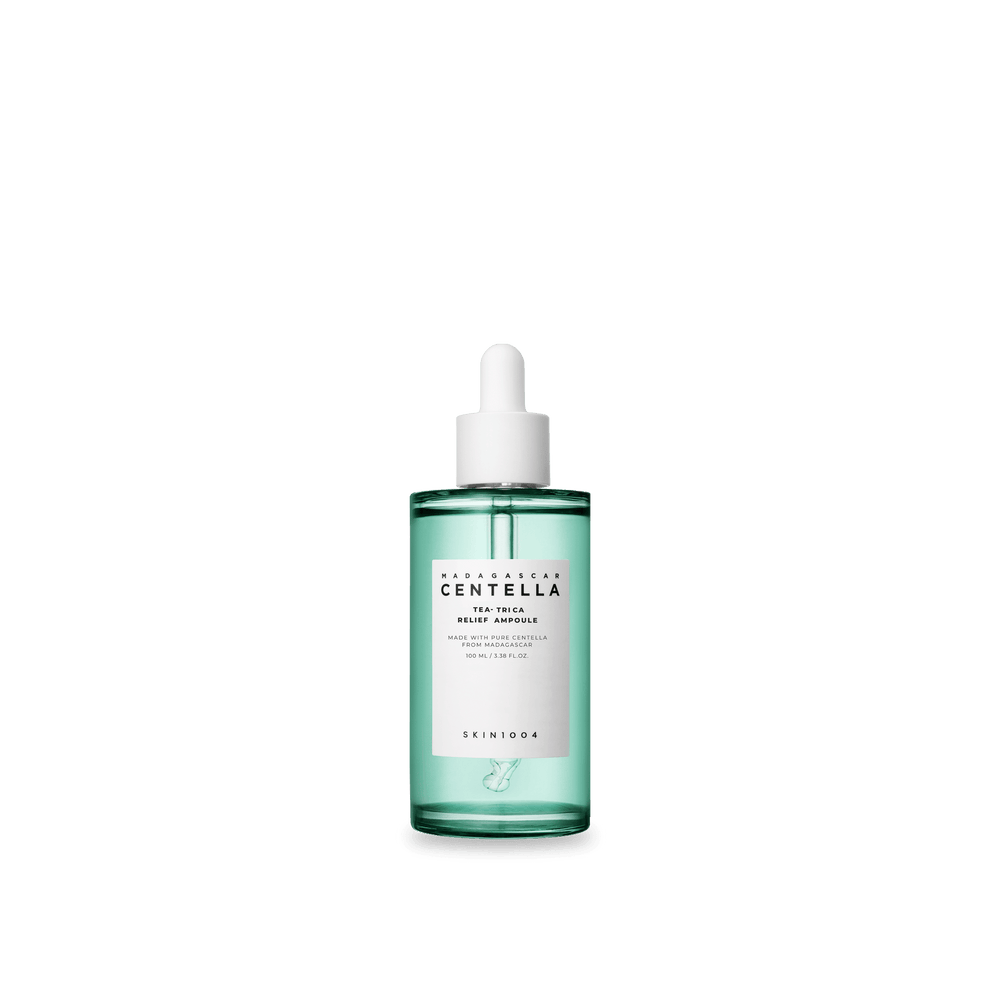
SKIN1004
SKIN1004 TEA-TRICA RELIEF AMPOULE 100ml
Built for skin that reacts to everything.
Twenty-three ingredients, and the absences are deliberate: no hyaluronic acid, no niacinamide, no peptides, no acid.
Water-thin, nothing to feel.

What this ampoule does
A 100 ml oil-free ampoule built on tea tree leaf water at position two, with Centella asiatica, hinoki cypress water and five humectant glycols. Nothing else.
A deliberately empty formula
Most ampoules are a list of actives. This one has two ingredients you could call active — Centella Asiatica Extract at nine and the tea tree distillate at two — and everything else is either water-binding or structural.
That is not laziness. There is a real case for a product like this: skin that is stinging, flaking or reacting does not need another active, it needs a break. An ampoule with no acid, no vitamin, no retinoid and no peptide is something you can use on a week when nothing else is tolerable, and it will still put water back.
Judge it that way and it is well made. Judge it as a treatment ampoule and you will be disappointed, because there is nothing in it to treat with.
Five glycols, and one that is not ordinary
Glycerin, Butylene Glycol, Dipropylene Glycol, Propanediol and Pentylene Glycol do the water-holding. So does Glycereth-26.
The one worth naming is Methyl Gluceth-20 at position five. It is built from glucose rather than petrochemical feedstock, holds more water per molecule than glycerin, and is markedly less sticky — which is why it appears in formulas meant to be layered several times. It is uncommon, and its position here is high.
The tea tree, in two forms
Melaleuca Alternifolia Leaf Water at two is the distillate — the water fraction left after steam distillation, which carries the scent and the water-soluble compounds but not the concentrated terpenes.
Melaleuca Alternifolia Leaf Oil at twenty is the essential oil itself, solubilised by Polyglyceryl-10 Laurate so it stays dissolved in a clear liquid.
That second one deserves a straight sentence. Tea tree oil is a recognised contact sensitiser for a minority of people, and this is a product called Relief, bought largely by people whose skin is already unhappy. It is at position twenty of twenty-three, so the amount is small — but if this ampoule stings, that is almost certainly why, and no other ingredient here is a plausible culprit.
Key ingredients
Ingredient · What it is, and what it is used for
- Melaleuca Alternifolia (Tea Tree) Leaf Water
- Distillate of tea tree leaf — the water fraction, not the concentrated oil. Second on this list.
- Centella Asiatica Extract
- Extract of Centella asiatica, whole plant. Used to calm irritation; used to slow oxidation. Ninth on this list.
- Methyl Gluceth-20
- Glucose-derived humectant. Holds more water than glycerin and feels far less sticky. Uncommon.
- Chamaecyparis Obtusa Water
- Distillate of hinoki cypress. Uncommon outside Korea and Japan.
- Glycereth-26
- Ethoxylated glycerin. Used to pull in water and hold it; thins the formula so it spreads.
- Glycerin
- Polyol. A material skin already contains, so it reads as its own; used to pull in water and hold it. Third on this list.
- Melaleuca Alternifolia (Tea Tree) Leaf Oil
- Essential oil of tea tree leaf. A recognised sensitiser for some people.
- Polyglyceryl-10 Laurate
- Polyglyceryl ester. Keeps the tea tree oil dissolved in a water-based formula.
- Pinus Palustris Leaf Extract
- Extract of longleaf pine needle.
- Pueraria Lobata Root Extract
- Extract of kudzu root. Pulls water into the surface and holds it there.
- Ulmus Davidiana Root Extract
- Extract of elm root.
- Ammonium Acryloyldimethyltaurate/VP Copolymer
- Acrylate copolymer. Sets how thick it is — this is what makes a watery formula feel like an ampoule.
How the formula works together
There is no oil phase, no emulsifier system, no silicone, no film former and no preservative that exists solely to preserve — Hydroxyacetophenone, 1,2-Hexanediol, Caprylyl Glycol, Pentylene Glycol and Ethylhexylglycerin cover that between them while also holding water.
Positions 17, 21, 22 and 23 are a four-plant block — longleaf pine, evening primrose flower, kudzu root and elm root. The same four appear together in the SKIN1004 sun milk and in formulas from several other Korean brands; it is one licensed complex rather than four decisions.
At 100 ml with a dropper, this is priced and sized to be used generously, which suits what it is.
Who it is for
Labelled for relief. Genuinely useful when your skin is over-exfoliated, wind-burnt or reacting to something else — it adds water and nothing to argue with. Contains tea tree essential oil, so patch test if you know you react to it. Not a treatment ampoule, and not sold here as one.
How to use it
- After cleansing, drop an appropriate amount and spread evenly.
- Pat to help it absorb.
- Layer two or three times when skin feels tight — the formula is thin enough for it.
- Follow with a cream. There is no lipid here, so the water you add will leave without one.
Details
- Size
- 100 ml
- Made in
- Korea
- Free of
- Acids, retinoids, vitamins, peptides, oil, silicone, alcohol, fragrance
- Contains
- Tea tree essential oil at position 20
- Ingredients
- 23, published in full below
Full ingredient list
Water, Melaleuca Alternifolia (Tea Tree) Leaf Water, Glycerin, Butylene Glycol, Methyl Gluceth-20, Dipropylene Glycol, Glycereth-26, 1,2-Hexanediol, Centella Asiatica Extract, Hydroxyacetophenone, Ammonium Acryloyldimethyltaurate/VP Copolymer, Propanediol, Polyglyceryl-10 Laurate, Ethylhexylglycerin, Pentylene Glycol, Caprylyl Glycol, Pinus Palustris Leaf Extract, Chamaecyparis Obtusa Water, Disodium EDTA, Melaleuca Alternifolia (Tea Tree) Leaf Oil, Oenothera Biennis (Evening Primrose) Flower Extract, Pueraria Lobata Root Extract, Ulmus Davidiana Root Extract
In label order, unedited.
Ships from Korea.


